Showing posts with label Psychology Study. Show all posts
Showing posts with label Psychology Study. Show all posts
Thursday, July 11, 2019
Control What Can Be Controlled
When it comes to executing a trade I hold two beliefs, control what you can control, and the only thing you can control is entering the trade. Once the trade is entered the shift is to self-control and therein lies the crux of trading. Self-control is setting the stop or alert. Self-control is setting targets. Self control is exiting when stopped or target hit. Self-control is following what was planned. Between these lines many things blur when capital is on the line.

Thursday, February 2, 2017
Test Driven Trading
In software development there is a technique called Test Driven Development which is a process of taking requirements of a project and breaking these requirements down into cases which will be accepted if proven. These test are often derived from user stories and are typically broken down into unit test which test expectation of a function or method, as well as integration test which test a feature from end to end.
There are two common ways of testing. One is to write the test the code is expected to pass first, and the other is to write the code then test against it. What I'm interested in exploring from these concepts is how traders can incorporate this thinking to test their plan, debug inefficiencies, as well as introduce new concepts without breaking the current flow of execution. How can traders approach their trading from the perspective of a software developer?
The process of an integration test can be used to develop a process from how to approach studying to setting alerts, entry, stop placement, and exit. Once we have applied the theory of integration test we can apply the concepts of unit test for handling the minutia of a trading plan whether it be entry, placing a stop, or exiting a position. For this I'm going to look at one specific syntactic approach: Given, When, Then.
Given, When, Then is a syntax that when coupled with Feature and Scenario complete an approach called Behavior Driven Development. In this approach a small chunk of the trading plan such as an exit can be broken down such as:
Feature: I have an open position
Scenario: Exiting the position
Given: A trade hits my target
When: I take half off
Then: I will move my stop to break even on remainder.
Feature: Half Sized Open Position
Scenario: Exiting the position
Given: A trade hit my target and I moved my stop to break even
When: Price hits 20% from entry
Then: I will exit the remainder position
Now, when reviewing previous trades or searching through previous winners we have a focused set of criteria to pay attention to. We can better understand how our previous trades would have worked under these guidelines. Additionally since these test are being applied to the minimal amount of execution on our part, complexity setting in can be more easily identified by noticing when the test are getting too verbose and have too many steps or moving parts. And, while these test may pass on past data, a complete integration test of this on one's actual trading plan may not work out as expected.
Simply because something worked in hindsight doesn't mean I will be able to execute. As such, whenever I make a modification to a critical part of my trading plan such as an exit, I drop down in size and take twenty trades. I don't assume I am going to act in accordance and can not presume potential frustration should this new exit technique not work under current market conditions or be psychologically comfortable to me. By dropping down in size I reduce the risk to capital and some of the stressors associated with a position size I may not be comfortable. Being undersized when using these parameters increases my chance of success in abiding by the rules and achieving a large enough sample size to be meaningfully analyzed.
Additionally, thinking in terms of test prevents straying from one's trading plan when making adjustments. Often when something isn't working traders will jump ship and adopt a different trading style instead of maintaining a consistent philosophy and making necessary adjustments. Through testing each function of the trading plan it become easier to isolate and identify where potential problems are creeping in and handle them accordingly.
There are two common ways of testing. One is to write the test the code is expected to pass first, and the other is to write the code then test against it. What I'm interested in exploring from these concepts is how traders can incorporate this thinking to test their plan, debug inefficiencies, as well as introduce new concepts without breaking the current flow of execution. How can traders approach their trading from the perspective of a software developer?
The process of an integration test can be used to develop a process from how to approach studying to setting alerts, entry, stop placement, and exit. Once we have applied the theory of integration test we can apply the concepts of unit test for handling the minutia of a trading plan whether it be entry, placing a stop, or exiting a position. For this I'm going to look at one specific syntactic approach: Given, When, Then.
Given, When, Then is a syntax that when coupled with Feature and Scenario complete an approach called Behavior Driven Development. In this approach a small chunk of the trading plan such as an exit can be broken down such as:
Feature: I have an open position
Scenario: Exiting the position
Given: A trade hits my target
When: I take half off
Then: I will move my stop to break even on remainder.
Feature: Half Sized Open Position
Scenario: Exiting the position
Given: A trade hit my target and I moved my stop to break even
When: Price hits 20% from entry
Then: I will exit the remainder position
Now, when reviewing previous trades or searching through previous winners we have a focused set of criteria to pay attention to. We can better understand how our previous trades would have worked under these guidelines. Additionally since these test are being applied to the minimal amount of execution on our part, complexity setting in can be more easily identified by noticing when the test are getting too verbose and have too many steps or moving parts. And, while these test may pass on past data, a complete integration test of this on one's actual trading plan may not work out as expected.
Simply because something worked in hindsight doesn't mean I will be able to execute. As such, whenever I make a modification to a critical part of my trading plan such as an exit, I drop down in size and take twenty trades. I don't assume I am going to act in accordance and can not presume potential frustration should this new exit technique not work under current market conditions or be psychologically comfortable to me. By dropping down in size I reduce the risk to capital and some of the stressors associated with a position size I may not be comfortable. Being undersized when using these parameters increases my chance of success in abiding by the rules and achieving a large enough sample size to be meaningfully analyzed.
Additionally, thinking in terms of test prevents straying from one's trading plan when making adjustments. Often when something isn't working traders will jump ship and adopt a different trading style instead of maintaining a consistent philosophy and making necessary adjustments. Through testing each function of the trading plan it become easier to isolate and identify where potential problems are creeping in and handle them accordingly.
Sunday, October 19, 2014
Don't Panic
One benefit of keeping consistent breadth metrics across multiple market cycles is being able to compare and contrast the nuances and contextualize the current market structure. The last correction of magnitude was the period of late July through August in 2011. This was a period where there was clear evidence of forced liquidation. As exhibited by the StockBee Market Monitor, across multiple time frames there was rapid deterioration as the 10 day differential of break outs to break downs shifted from 509 to -5566 in 8 days, the secondary indicator went from 542 to -3596, and the primary to -2050 during this stretch.
 |
| This Is Panic |
In comparison it has taken 20 days for the break out to break down differential to shift from a modest -9 to -1529. During this stretch the secondary went from 100 to -1840, and the primary from 20 to -737.
 |
| This Is Not Panic |
What can be gleamed from this is that while there has been distribution and the market is currently under pressure and exhibiting a greater out flow from stocks, in relation to what a rush to exit looks like, this doesn’t even qualify. In other words, this is far from a panic situation.
Unfortunately, this is about as far as one can extrapolate the narrative. Knowing what is occurring now, the only important induction is whether or not this is a tradeable environment on one’s time frame or not. Merely because it has yet to reach panic proportions we can not assume anything further then the evidence. We will not know when it will or how it will realign. We do not know if there will be a tradeable bounce, a failure and retest of lows, a prolonged period of sideways consolidation, or the reemergence of V-shaped recoveries.
The best that can be done is to foreshadow scenarios and plan and act accordingly based upon our signals and set ups. Being aware of the confluence of signals that confirm our view or the divergence that negate it and acting upon these perspectives in a probabilistic mind set with proper risk control and pedal to the metal or stop gap measures is what should be strived for when managing uncertainty.
Sunday, September 7, 2014
The Tao of Trading
Tao give birth to oneOne gives birth to twoTwo gives birth to threeThree gives birth to ten thousand beings --Lao Tzu
If I were to describe my style of trading, the Tao would be a good place to begin. In a nutshell I look for contraction/expansion cycles to trade a burst of momentum over a 5 to 10 day window. The Tao is an example of a contraction/expansion cycle that begins with a burst as the Tao gives birth to one. A recent example of this cycle is BIDU which had a burst after a prolonged period of contraction.
 |
| BIDU |
Another recent example is LEAF. This examples shows the benefit of abstracting our thought process and thinking in chunks. Our time in the market and expectation after entry comes down to whether or not “one gives birth to two” and “two gives birth to three.” If this does not happen, this is not Tao. LEAF was clearly Tao over the past few sessions.
 |
| LEAF |
Another means of abstraction of price movement after entry is to associate with a process outside of trading. For myself I’ve been thinking more in terms of my opening repertoire in chess. There is little energy or thought in my moves as they are memorized to the 10th move or further. By chunking price moves in association with chess moves I’ve found it much easier to accept when a position is not going as intended and a surprise move has been played. Applying this to LQ there is one situation in which price action moved in accordance to my repertoire and one when it did not.
 |
| LQ |
The only correct exit in trading is the planned exit. A great benefit of this is approach is that it assist in avoiding results oriented processing. Another benefit of applying scenarios we have planned out and executed in other fields to trading is that it helps us associate the same neural networks we've chunked along with associating a set of procedures abstracted to price action which assist us in consistently analyzing post entry price action. We can avoid micromanaging post trade price oscillations that are often detrimental to consistent results and move more towards thinking in terms of the Tao did not give birth to two so exit.
Friday, July 11, 2014
Divorcing Time Frames
Knowing our time in the market can
greatly assist us as traders in our timing of the market. One of the
errors that traders compound is working off of two different time
frames. This can result in unnecessary conflict as the emerging
emotions of one time period may supersede the disciplined required on
another. Recently I underwent this experience when a longer term
holding period was pressured on a shorter term time frame and I sold
the position only to watch it rebound to new highs. I allowed a
shorter term time horizon bearishness to override the a plan that
thus far kept me pat for 3 months.
If you are a short-term trader, recognize that selling a stock for a quick profit only to watch it go on to double in price is of no real concern to you. You operate in a particular zone of a stock’s price continuum, and someone else may operate in a totally different area of the curve. However, if you’re a longer-term investor, there will be many times when you make a decent short-term gain only to give it all back in the pursuit of a larger move. --Mark Minervini
Over time traders begin to develop default behaviorism arising from experience and intuition. One of the things to be cautious of is that the default capital preservation of a system devised for a shorter time time frame of 5 days can override a longer time horizon system which can in turn become an exceptional costly mistake. The longer capital is tied up in a position the more crucial it is that this position be allowed an opportunity for an outsized gain on this horizon.
Thursday, February 6, 2014
Our Trading Data Lies to Us
We are only as good as our data source and our data source is often inconsistent if not outright misleading. I’m not 100% sure if realizing this earlier would have improved my trading but I understand it now much more vividly and it has altered my approach, especially in stock scanning. One would think that the most simple of data points, a stocks float, would be constant across multiple providers, but it’s not. Ex: SNCR- 18.2M from TeleChart, 34.4M from FinViz, and 21.15M from Yahoo.
What about volume? Well, TeleChart’s volume is provided through BATS and often TC rounds, so 2.4M today, 2,363,466 from FinViz, and 2,364,181 from Yahoo. And keep in mind this is just the known volume on the session and does not include dark pools so we can assume it’s probably much higher than any of these numbers. And Price? Our charts deceive us here as not every price tick gets recorded and this results in the fact that the days high and low may not be accurate not only because of dark pools, but sub-100 lots will not register a tick on the end of day chart.
What about earnings? Today FLDM had earnings and ThinkorSwim has an estimate of -0.18 with an actual of -0.15. Briefing has and estimate of -0.13 and an actual of -0.04. Now I understand how analyst estimates can be site dependent, but the actual result should have no wiggle room what so ever.
Trading is a game of incomplete information and so is our trading data. This can effect our entire trading plan from our vehicle selection and which stocks enter our universe and which do not based upon our scans as well as the criteria we use to build them. This can effect our entry signals based upon which source has the most current and up to date information let alone the most accurate. This can effect what type of alerts we use and what combination of criteria they are based upon. This can effect how much we choose to micro-manage our trading.
What I’ve taken from this realization most is acceptance that there is an inexactness to trading and to release the tension of perfection in making sure I have the best candidates to trade. I no longer worry that I have the most precise entry requirements. When price runs through an alert but it never triggers and I lose profit as a result of not exiting at my target or my stop runs slightly and my loss is larger, I’m much more at ease in letting it go. In other words I’m learning remove precision, allow for sloppiness, and be OK with keeping it simpler.
Wednesday, October 16, 2013
Wednesday, September 25, 2013
Mistakes and Moving Forward
I am a patient boy
I wait I wait I wait I wait
My time is like water down a drain
...
I'm planning a big surprise
I'm gonna fight for what I want to be
And I won't make the same mistake
Because I know how much time that wastes -Fugazi
Albert Einstein stated, “Insanity: doing the same thing over and over again and expecting different results.” However, another genius would beg to differ as the following quote (one of many variations) attributed to Thomas Edison regarding his invention of the light bulb shows, “I have not failed 10,000 times. I have not failed once. I have succeeded in proving that those 10,000 ways will not work. When I have eliminated the ways that will not work, I will find the way that will work.”
Notable trader and “Market Wizard” Linda Raschke has stated the following, “I only had to make the same mistake about 100 times before I learned (i.e. you can get overconfident, start trading too large, and make other mistakes). I didn't learn from making the same mistakes just twice. It can take repeated bashing of the head for something to sink into the skull.”
Today I felt like I needed a bit of catharsis and in the process share the frustration resulting from making the same mistake repeatedly as well as recovering and moving forward. I embody this Rashke quote in nearly all I do. I repeat the same mistakes, sometimes knowingly, and sometimes in the pursuit of a different answer (right or wrong) or a more elegant solution. I repeat the same mistakes because sometimes I don't learn the first time and sometimes I don't learn the tenth time and sometimes I may not learn at all; however, when I do learn it sticks and from that point forward the knowledge is mine.
I've been repeating a similar mistake for well over three years now. The main reason I still have skin in this game is because I have learned to keep my losses small --with the occasional hiccup --and I have been marginally profitable even though it seems I've tried everything in the book to assure antithesis of this order. I've maintained the stance that I am biding my time until my experience catches up with my knowledge and have done my best to assure this is the case by limiting draw downs to my capital and being in general a risk averse trader while progressing into a risk aware trader. In part I've succeeded in this by trading small and being scared shitless.
The second smart thing I did was try as best as possible to stick to one ideology and this was momentum. My tactics, entries, exits, holding periods, stop placement, position size etc... has been fiddled around with repeatedly and perhaps detrimentally, however my general approach has remained the same through out. My daily bread has been a focus on momentum stocks and range expansion but admittedly I've experimented around with these parameters which is a natural progression in trading because as experience and time in the market grows so does the understanding of the underlying mechanics and structure of the market. I don't begrudge myself for doing this at all.
The third smart thing I did was seek help which was one of the most difficult admittance in the world for me to do as I am prideful of figuring things out for myself and doing things on my own. For whatever reason, when I made a commitment to improving myself as a trader I realized I would do what ever it takes hubris be damned to progress down the path even if it meant asking for assistance, something that mortified me. It meant accepting that I was human and I couldn't do everything on my own and it isn't necessarily being a burden upon another in seeking guidance. And so one day after a horrific trade (one that was actually profitable by the way but didn't follow my rules) I threw myself into the pyre and sent a raw journal entry to a total stranger. That journal entry became a blog post on philpearlman.com
This was the beginning of the turning point for me. What was echoing within the confines of my mind was finally externalized and was a surprisingly uplifting experience. In the pursuit of my passion I exposed myself to another who didn't know me but merely accepted me based upon an imploring outreach to become better at what I wanted to do. For this I am eternally grateful and from this a new plot was being toiled.
So what does all this bloviating boil down to? I'm a phenomenal scanner. I can scan like nobodies business, but it's not about the scans. I've improved considerably at pulling the trigger on entries and taking my losses, so I'll give myself a pat on the back. I'm still pretty weak when it comes to filtering a lot of the trading data I follow into meaningful information and maintaining and tracking quality watch list. I still really, really, really, really suck at trade management. I suck so hard at this that I missed an opportunity to increase my account size by 20%.
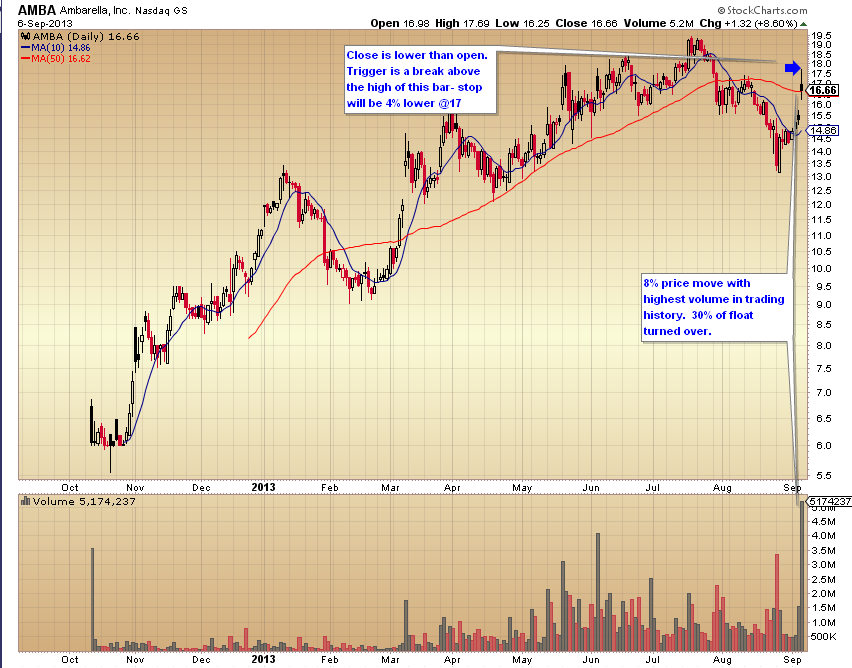
How? I didn't follow the plan. Immediately after entry price continued in my direction for 2 more days --hooray --before it pulled back over the next 9 –Rut-Roh!-- and I sold when price returned to my entry point as I was unwilling to accept the possibility that this might turn into a loss after such a promising start. Of course the following day price put in a pivot low, above my stop level, and never looked back again. That trade was MAKO.
 |
| MAKO Entry |
 |
| MAKO Trade Management |
 |
| Try, Try Again |
Through all the trial and error over the past few years there are a couple of things I know- I've persisted and I haven't blown up. Along the way I've learned a few other things, most importantly that I'm finally beginning to get a rhythm and style and cadence that suits me and I am understanding the market on my terms, which is invaluable. I've taken the pot holed road of many weary traders and I've come to where two roads divide and I'm choosing not to take either because I'm going to blaze my own right down the middle. It may take longer, and it may not be as scenic, it may be filled with hundreds of mistakes, but in the end it will be more satisfying because it will be my path.
So here's my deal to myself. I have three positions open that were taken with a similar set up and the exact same trading guidelines as the MAKO trade. I have not fucked these up. I do not have any false expectations that these will return 20% to my account, but I do feel like today's crack on the head was sufficiently skull numbing and the lump left behind will still be noticeably protruding for the duration of these trades that I will not make this same mistake. I have no delusions that I still won't make other mistakes and do so repeatedly because that's how I am, and even if that wasn't the case there are enough trader tombstones of those who didn't learn from theirs littering the landscape to keep things in perspective.
On a side note, oddly enough, today while I was beginning to journal my response to the MAKO news there was a related post to what I was undergoing by Darren Miller published on SeeItMarket.com/ that I think is well worth reading.
 |
| AMBA |
 |
| AMBA Hypothesis Prior to Entry |
 |
| RKUS |
 |
| SIGM |
Friday, August 16, 2013
Be Calm and Mind the Gap
Thus far this year every market hiccup
has been met with hyperventilating and each dip has been bought in
short order punishing early shorts and exiting longs. With this
recent gap down the psychology has once again become a battle of: is
this it or buy the dip? Thinking in terms of the market exerting the
most pain upon the most participants, what scenario might likely
cause this? Given that buy the dip has become conditioned, what
scenario might cause maximum pain: dip buyers returning, shorts
sitting sidelined, and the market continuing to erode comes to mind.
But it's difficult to see this with conviction when at a moments
notice the Hand of Bernanke can sweep across the market like
Maradona's Hand of God.
Through 2013 I've noticed I've become
conditioned to this and to ignore market breadth and divergences
because they haven't really mattered. Each FED kerfuffle has been
met with FED assurances as they continue to inject the market with
steroidal liquidity where the long ball going yard has trumped the
underlying basic fundamentals of market mechanics and structure.
What this has reinforced to me is that market structures modify and
that not everything works all the time. It has also made me more
mindful that when it comes to the utmost rudimentary basics of market
participants, not much has or will change for regardless of what the
influence upon the market is –there will always be something
–because it's the reaction to it and recognizing the nuance of it
and being able to plan accordingly that will continue to matter.
What this has also affirmed is that the
market is a constant testing ground of one's style and method,
process and discipline, especially when something is not working in
expectation or according to historical precedent. There's the
constant lure of style drift or chasing the tail mentality to mold to
the flavor of the month and what is working today.
Be calm and mind the gap and think in
terms of not what this means about the market, but what this means
about you as a participant in the market and what you do from here.
Wednesday, August 14, 2013
The Slap Heard 'Round the World
Nobody knows better than me. This
statement may come across as hubris, and when it comes to life I
fully admit this is not completely accurate; however, when it comes
to trading and putting up my own capital this egocentric statement is
closer to truth than fiction. The problem is that I don't always
know any better and sometimes when I do know better I don't necessarily
act any better. Where this weakness has become glaringly obvious is
how I interpret and react to news events.
Recently I started thinking about a
number of different news stories and the effect they had upon my
decision making process and subsequent actions. More often then not
I found myself on the zig instead of zag treadmill. What I've
concluded is that I've given too much credit to folks who get paid
for their ideas or the number of words per article instead of what
truly matters –market reaction. I've even been seduced by the
opinions of those who have more experience than myself and those that
have shown a track record of taking money out of the market, but what
I've ultimately decided is that as someone who trades their own
capital, I'm the only one who knows better.
A story I have gone back to and
reviewed has been Greece. The reason I have done so is that I was
reminded of Greece because I've no longer been hearing about Greece.
For a period of time this was the only story discussed and it was
becoming a very negative one. Where I last left off before turning
away from the subject in disgust was when the banter began to become
sophomoric political theory verging on xenophobia. When the story
started to become about black shirted jackbooted thugs romper
stomping the streets of Athens I had reached my limit. Would Greece
really go down that road?
Then there was this:
Clearly the answer to me was becoming
yes, Greece was going down that road. But then an odd thing
happened. That slap heard round the world coincided with the Athens
market bottoming and moving up 100% trough to peak. Funny thing is,
I don't recall seeing this in the news at all. With the exception of
the fear published about a run on Cypress banks, it was as if this story just disappeared
without a trace while the index quietly doubled.
 |
| $ATG |
As a market participant it's crucial to
keep an open mind and be vigilant and keep on alert and focused for
opportunities as they arise. Sometimes these happen to be
counter-intuitive and some times these happen to come when there is
literally blood on the streets. Sometimes these happen when everyone
forgets what is was they were worried about to begin with. Now that Greece is back on my radar the follow up for me is, is there opportunity and a potential theme playing out that should be paid attention to going forward?
Thursday, July 4, 2013
The Observer Effect
If I were to answer why I started to
blog about trading I would begin with where I left off long ago, the
desire to write. Through trading I wanted to satiate an appetite
that was better left suppressed and hungry, my creativity. I believe
being clever and coming up with something novel is a consistent theme
in the early stages of trading and instead of pursuing the path to
riches, the highway of brilliancy is sped down like the autobahn. I
thought for a while I could come up with some unseen nuance to the
market that would give me an edge that 10,000 Ph.D.'s monkeys with
10,000 supercomputers had not found. Eventually rationalization set
in and I realized this energy was better spent elsewhere and it was
time to return to writing.
I thought blogging would be a
disciplined process of journaling, something that I could do for
enjoyment as well as being a trail of bread crumbs that would lead
me to the fruits of my labor: some edible and some rotten. One of
the difficulties I've found in penning on paper is the inability to
search key words or find key graphs and images that tell a story.
I've tried to compensate by using different colored pens and drawings
to highlight important sections to return to but I honestly rarely
do. In addition to a number of sketch books inked from front to back
there are thousands of files on my lap top to peruse as well, but
often these documents do not see the light of day. It's too easy to
stow these away as if they were a legend of antiquity, only to be
opened for ritual or ceremony. By publishing some of my notes and
thoughts publicly there would be an audience that at anytime could
access them which gave me the sensation of some exposure. I felt
that my ideas were no longer under lock and key rattling around my
skull but open to rebuttal and feedback.
There were some unintended consequences
of all this as well. I began to suffer the observer effect. Besides
simply expressing some ideas I started to become those ideas, or felt
responsible enough for those ideas that even if I changed my
perspective or view a few days later I had an obligation to abide by
them regardless. I was becoming self-aware of the process itself and
seeking validation in the number of responses or hits for
encouragement to continue to post at all and if so, to post what was
getting the most views rather than where I was heading as a trader.
It was becoming a self-referential cycle that was actually stagnating
me somewhat as I was morphing into a composite of my most read
pieces, some of which were mostly experimental or merely thought
exercises.
What this led to was a decision to stop
blogging for a period and take a step back. To stop journaling as
much and take another step back. To stop thinking so much and take a
further step back until I was a few yards outside myself observing
the observer. From this vantage point I started to turn the
self-awareness into mindfulness and instead of constantly writing
free-flow association of the process of me doing, I merely jotted
down a few notes daily of what I observed myself doing and what was
most significant to begin changing. Instead of having an essay I
simplified into haiku form and posted an index card next to my lap
top as a daily reminder of the two to three trading task that were
most important for me to instill into habit over a 28 day cycle.
Everything else was stripped out and streamlined so that these few
task took precedence above all else.
In the end I realize there is little
difference between what I observed from what I've been writing down
over the past couple of years. The primary distinction is that one
is through my eyes and the other the projection upon my eyelids. One
vision was trying to tackle everything imaginable and the other is
trying to resolve what is manageable. One is who I am in general and
the other through cohesion and conciseness. Sometimes moving one
step forward requires three steps back.
Monday, April 15, 2013
Whiplash I Was Taking a Bath
Some valuable lessons were learned this
past week. It would have been more agreeable to me had the short
signal on TNA worked, but when it failed I was conditioned
sufficiently by this market to buy the dip even though in the back of
my mind I was suspicious of each and everyone. Suffice to say all
the positions I took failed but at least I salvaged some capital by
exiting two at break even while taking losses on the remaining. In
retrospect it would have been better to remain on the sidelines, but
that is no longer here nor there because as traders the market in
front of us is the only information available.
What this got me thinking about is how
much noise I allow into my process and how much of it is beneficial
versus detrimental. This is a fine line when beginning this journey
and one I've clearly not come to a conclusion about. Up to a certain
point it's a necessity to branch out and absorb as much information
and data as possible. This is learning. However, in the constant
pursuit of market knowledge, eventually there must be a reliance upon
one's own beliefs and signals. It's all too easy to be assuaged by
the comments of others or dissuaded of one's own thoughts due to a
constant barrage of disseminated information. It's not an easy
answer finding out when this is.
Thursday, March 28, 2013
Coming Down the Mountain
It's been 9 trading sessions since the
Cyprus news broke and the markets reflected this by closing at fresh
highs today. Early last week I did a thought exercise and reflected
upon the event and what I thought may happen as a result. In the
process I contemplate the man from the mountain that Livermore spoke
of who was far removed from the daily machinations of the market and
received his news days late. So, what would he think receiving
today's close a few days from now? I don't foresee him coming down
from the Sierras along Route 49 come Monday with his brown bear in tow making any raids. The Cyprus news according to the market is a
non-event.
As a market timer with a set of tools
to decide when the market is best suitable for trading the past month
has been a little difficult to say the least. I was already on edge
and looking for excuses to exit the market so when the Cyprus news
hit I figured surely this would be the news that cracked the up
trend. It didn't help that I also peruse the writings of other timers
who more or less have come to similar conclusions about the state of
breadth. Essentially I created my own echo chamber and came to
erroneous conclusions.
I recently picked up the new
Kacher/Morales book, “In the Trading Cockpit with the O'Neil
Disciples” and there was one passage that resonated,
From a practical standpoint, the simple fact that we were able to generate a mid-double-digit return in 2011 during a year where there were zero successful follow-through days proves that the follow-though day is, all by itself, not a critical indicator. It is a contextual indicator, and the greatest analytical skill any investor can develop is the ability to employ judgment in understanding the contextual effects at work with respect to the effectiveness of follow-through days or any other type of directional signal... pg.36
Moving forward one of my goals will be refocusing the energy
and effort that I've spent upon breadth and move towards better
understanding of the context of the market at a given time by orienting myself through set-ups. Regardless of the market environment there will always be an opportunity. For the
near future I'll be spending much more time on market mechanics and analysis, as well as my tactics and strategy and submitting to uncertainty.
One of the major drawbacks I've experienced through not submitting to uncertainty and having preordained outcomes to news specific events is that it has narrowed down my focus and prevented me from looking for opportunity in the market place and signals to trade. All too often I caught myself thinking, "Why am I not in that stock?" When I started to actually answer that question honestly every single time, to my surprise I've actually found myself in a few of them.
Monday, March 18, 2013
On the Third Day
I hold strong opinions about what is
happening in Cyprus and I plan on keeping them to myself. While this
blog is my soapbox, it's not intended for me to pontificate my belief
system other than it applies to trading stocks. I don't think it's
appropriate to blur that distinction at this juncture, but on the
other hand it's nearly possible to personally avoid what my thoughts
are regarding this situation and my ensuing trading in lieu of.
I prepared myself last night for a
panic situation and how I would react and what I would do that was in
my best interest as a trader. My focus first and foremost was to
preserve as much profits as possible on open positions that had some,
and preserve as much capital as possible on positions that were flat
or underwater. I had little interest in trading the volatility or
looking for potential profit opportunities that present themselves
during such catalyst driven events. I wasn't interested in buying
the dip or looking for shorts, I simply wanted to avoid panicking and
stampeding with the herd.
When I went to sleep last night the
futures looked bleak, and when I awoke there was some improvement but
not significantly so. I reread the notes I made and my plan of
action, knew where all the stops on my positions were and knew where
I would take profits if possible. I also sequestered myself by
making sure my browsers were closed and that I didn't read any news
or opining on twitter. I avoided poisoning my well with undue
influence of what others were doing or thought. I was mentally
prepared to hear my alerts go off like a church bell at noon on the
open but then a funny thing happened, the church bell struck two.
One alert was to take profit on a position I held for a month, and
the other was to exit flat a position I've held for 9 days now, and
that was the extent of it. Nothing happened as I expected it to.
There's nothing in my trading plan that
specifically says what to do in a situation such as Cyprus. I
suppose I could draw up a generic sub-heading on headline risk and
what to do as a result of market shock, or perhaps better yet go
through major market shocks and note the subsequent reaction, but I
suspect this would simply create more complications than maintaining
a more simplified approach of if my stops are hit exit. If I make
caveats that if my stops are hit due to an event specific catalyst
and therefor I'll hold expecting a rebound, what's to stop me from
doing so again should my stop get hit by any other randomness? If I
have gauged my appetite for market risk accordingly and wisely it
should merely be accepted exposure.
Phil Pealman of StockTwits wrote a blog
piece today "Panicking About Cyprus? Here's What to do First..." that I believe is well worth reading and a
through exercise well wroth doing. He begins “If you were panicky
last night or this morning because of Cyprus, take some minutes today
to write yourself a letter describing in detail your experience.”
In part, this is what my post is accomplishing and later tonight I'll
flesh out some more personal thoughts in my journal, but I think this
is an excellent way work through the anticipation, expectation, and
experience from a day like today.
From this process I've decided to frame
the experience through a few references.
First is an informative tweet yesterday
on StockTwits by Jon Boorman : “So no-one predicts the bailout and
'deposit tax', but now everyone thinks they can predict exactly what
markets will do tomorrow #Cyprus”
The next day we go the news of the San Francisco earthquake. It was an awful disaster. But the market opened down only a couple of points and the public never is independently responsive to news. You see that all the time. If there is a solid bull foundation, for instance, whether or not what the papers call bull manipulation is going on at the same time, certain news items fail to have the effect they would have if the Street was bearish. It is all in the state of sentiment at the time. In this case the Street did not appraise the extent of the catastrophe because it didn't wish to. Before the day was over prices came back.
… The Street paid no attention to the earthquake the first day or two. They'll tell you that it was because the first dispatches were not so alarming, but I think it was because it took so long to change the point of view of the public toward the securities markets. Even the professional traders for the most part were slow and shortsighted. Reminiscences of a Stock Operator
I can’t think of a time in nearly 20 years of playing this game that I haven’t looked back on a macro inspired gap and wished I would have reacted FASTER. It has nearly always been the case that observing would have paid better dividends than simply reacting. ZenPenny
Many years ago I heard of a remarkably successful speculator who lived in the California mountains and received quotations three days old...
…I like to be away where I can think. You see. I keep a record of what has happened, after it has happened, and it gives me a rather clear picture of what markets are doing. Real movements do not end the day they start. It takes time to complete the end of a genuine movement. By being up in the mountains I am in position to give these movements all the time they need. How To Trade in Stocks -Jesse Livermore
I imagine Nicholas Darvas off in some
remote Asian city dancing while this news flow hit and think what
would he be doing. Well, dancing obviously. The events that
transpired would not be known to him for a couple more days and the
ensuing result for a few more thereafter. Essentially it wouldn't
matter because his stops take care of the business end of the
transaction from such events. The old man in the mountain which was
obviously the influence of this aspect of Darvas' system the same.
Livermore himself notes that it takes a few days for the information
to filter and gain perspective.
The valuable lesson that I wish to
carry forward from this day is to avoid as much as possible my
immediate gut reaction that such news driven catalyst can have upon my
decision making process and instead submit to acceptance of the
reasons my stops are in place to begin with. At times I
differentiate between reasons why I get stopped out and feel that
some are more valid and acceptable than others. I despise getting
stopped out of a position the same day I enter but am more accepting
if it happens a week later, but the end result is being stopped out
and it shouldn't matter how I arrived there.
Another lesson is when news like this
hits, it's better to stick to the program with the additional caution
of avoiding news sources as much as possible in order to avoid being persuaded
to alter my plan of action when I entered a stock in the first place.
Regardless of what my personal opinions are on the subject it is of
no relevance to the market. The market does what it does and I can
only control what I can control and try as best as possible to be
open the the information the market gives off and try to be as
impartial as possible. How I as an individual might react due to
such news is not indicative of how the collective market as a group
will react.
One more I take from this is to attempt
to hold off for a couple of days making decisions after a news driven
catalyst of significance. The outcome closest to the event may be
180 degrees different from the results of the event a few days down
the road. It's perfectly fine to hold off making a decision until
the news has time to settle.
Saturday, July 7, 2012
It Just Doesn't Matter
I've experienced at least a dozen ways in which a trade can go south and I'm sure I'll experience a dozen more I hadn't even thought of. I've stopped keeping track of the number of times I was top ticked and found it too demoralizing to continue tracking the number of times my stop was bottom ticked only to watch price rebound to new highs. I was surprised to find out that there are ticks you can get filled at below the low of the day; yes, that's correct, the printed low of the day may not have been the actual low. I stopped keeping track of the number of times price came within a penny of my exit target alert only to close out at the end of the day below my entry –or worse –stopped out. But, you know what... It just doesn't matter.
Something I've been working on in my trading lately is taking another shot at a stock that I've exited or been stopped out on. Usually I'd find a few or more reasons not to reenter such as not wanting to deal with wash rules, or not being able to handle taking a second loss on the same stock so soon afterward. The problem with this is that it is anathema to the way world class traders think and act. World class traders will take multiple shots on the same stock if they still define it as a quality set up with an edge and a valid entry signal as defined by their rules. This is what matters to them, not the emotional attachment to a ticker and the recent experience of taking a loss or two. It's about the set ups and not the bias to a particular symbol.
Bias to a symbol is a common theme with greater repercussions than one might think. It is in part why I would not take another shot on the same stock, and it's also why at times I'll have a more favorable view of a set up if I know what the symbol is regardless of how less than stellar the chart may look. So, in order to think and therefor act like a trader I've made a conscious decision to get over the hump by occasionally taking another entry. This past week LF was my stock.
One of my rules based upon assessment of my trades is to exit a stock if it closes lower than my entry. Empirically this makes sense because why should I be long something that is not going up? Emotionally however, this was a difficult hurdle for me to overcome as it forced me into accepting a number of scratch trade which increased my losing percentage and string of losses as well as having the appearance of adding up to a significant amount; however, my statistics don't lie and coming to grips with the simple fact that this is a high probability failure trade on my time frame finally convinced me it's acceptable to take a larger number of small losses and increase the frequency of my trading (I had to spend a lot of time improving trade management, but that's another story). With this in mind I took an entry signal on LF on Monday and closed it at the end of the day and ditto for Tuesday. Come Thursday I witnessed, much to my chagrin, LF bolting out the gate and up nearly 6% before my scan alerted me.
Now I was faced with a dilemma, let it pass and miss out on what's been setting up to be a good trade opportunity or take a third shot and, heaven forbid, watch it reverse hard on me and get stopped out a third time. I took a few moments to contemplate and noted that it was currently priced at my maximum chase point on a stock at this price level, 6%. I decided to take the trade, it was still a good set up.
Quickly the entry was confirmed as the price continued higher and I found myself up 5%. It seems just as quickly maximum adversity kicked in like steel toes to my teeth and the market sent a simple reminder to me that no matter how solid the set up, anything can and will happen, especially when least expected or prepared. Conveniently the stock was downgraded and after hour news hit the wire that the CFO was resigning and I was quickly preparing myself for the acceptance that the stock would gap down like a stone. Regardless of how I felt about the downgrade being a bullshit call, particularly since it was done during market hours which is rare, and irrespective that I didn't believe the CFO resignation was an issue, I didn't expect the market reaction to take this view and basically accepted this would be a loss.
The set up was sound, the entry within reason, and the amount risked tolerable. I took a shot, and then another, and finally one more. This I can control. Entering and getting stopped out 30 seconds later I can not. Entering and having a BS downgrade that could have been done premarket instead of during hours and after an 11% move I can not. In the end, however, it just doesn't matter. It just doesn't matter how the trade gets from A-Z as long as it's part of plan. Yes it may at times be an emotional roller coaster and yes sometimes will be more difficult than others, but in the scheme of things it's just one trade and it just doesn't matter. Occasionally there will be that isolated trade that stings and hurts so badly it flashes before your eyes before you take a signal, but over time these become fewer and farther between. As my sample size grows larger these trades shrink, and in the grander scheme of things, it just doesn't matter. One thing that truly matters is trading with a solid plan that allows one to get to this point that it just doesn't matter.
Wednesday, June 27, 2012
Anticipation
If there is an environment cleverly schemed to take advantage of people's behavior it's casinos. Walk into any casino and immediately you're hit by flashing lights and the sounds of bells and clinking coins. Once the door closes the tinted windows make it difficult to distinguish night from day in an attempt to make time cease to exists. Even if you looked you'd be hard pressed to find a clock anyways but don't worry about getting too tired because the pumped in oxygen will keep you alert.
If you care for a game of skill where your knowledge will give you an edge you'll have to walk the gauntlet of the games of chance and maybe you'll get lost and decide to throw down a few bucks on the wheel and have a cocktail because the room you;re looking for is usually hidden in a corner away from it all or in a separate part of the casino down some hallway. And when you've finally called it a day you may just toss down a lucky buck at the slots on the way you. It's all cleverly thought out to milk the cash from the cow.
The most cleverly designed machine of cash extraction is the slot machine. For every dollar the expected return is a few tenths of a percentage less but that doesn't seem to keep the herd from sitting down and using three at a time. Slots are specially designed to exploit what I discussed about in a previous post, anticipation and the false expectation of a series after two data points. When the first 7 hits the anticipation builds and when a second the pleasure response begins to fire even more in expectation of that third seven. What's more nefarious about these machines for those that play them is that this anticipation occurs long before before pulling the lever, it begins entering the door and that's in part why they are at the entrance.
I don't play slots but I did mention being influenced by a few traders I follow on twitter who were taking positions a week back. At the time I was trying to deduce what they were seeing and these two behaviorism were what I choose to explain it to myself. The reason I bring this up again is because they were at it again today as one began making inference that he was taking positions and the other was talking about taking light positions here. So today I wanted to return again and chart their mentions.
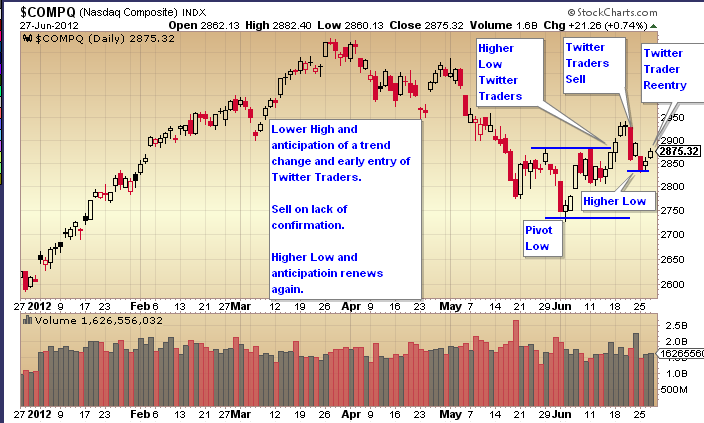 |
| Tracking Twitter Trend |
We live in unprecedented times where even if you lived on the tundra as long as you have a net connection you can get access to world class traders who will engage with you and are willing to take time to teach you through webinars. I don't expect myself to be aware of all the nuances they see or understand, however that doesn't mean I shouldn't take the time to process what they say. In order to make it understandable to myself I chose to use what I've learned through modern neuroscience and casinos so that it becomes meaningful and sticks, but next time I might use a Grimm's Fairytale, a fractured fairytale, or those loveable magpies Heckle and Jeckle. The point being, be aware of what they say and take notes and internalize it because as traders we're lucky to have it.
Now, on to breadth. Today was a key day as indicated by the Russell which outperformed today and showed great strength closing near the highs of the day. I'm still of the belief that if there is going to be a sustainable rally small caps need to take part otherwise money just keeps flowing like water into the stale bread leaders. New leadership comes from small caps so today was very positive.
 |
| Russell |
In addition today the secondary indicator I use crossed over again.
 |
| Secondary |
Lastly, the 10 day differential of buying to selling has been improving. Granted the underlying buying pressure has been modest, but the heavier distribution that the market has seen over the past few months has been waning as well. This become clearer when looking at the raw numbers.
 |
| 10 Day Differential |
 |
| Raw Numbers |
The main focus now is honing in on stocks that are showing relative strength because if the market will begin a new leg up the correction over the past few months should start showing up on the charts and quality set ups should stick out like a sore thumb.
Friday, June 8, 2012
Hack Your Trading
 |
| A Green Shoot |
Today a blip of green flashed across my timing signal. It's the first shade of green seen in a month, but I stopped trading long before that. If there is one thing I have improved upon in my trading it's avoiding the down turn and preserving capital. Having spent the past week going over my trades again looking for inconsistencies one constant has stood out repeatedly, giving too much back during down swings by trading through them and not having enough discipline to just step aside and let things work out. This time when my signals began to flip one by one I didn't wait for them all before stopping myself out of the market and sitting on my hands.
Suffice to say it's been frustrating being benched but instead of being demoralized by the thought that it may be weeks or months before the market aligns properly with myself I opted this time to put the energy into working on my weaknesses and spend more time improving my leaks and working on my analysis and planning, and process and method.
I also realized that I had reams of information scattered all over and that there was a lot of wasted effort and energy that could be streamlined so I started investigating Evernote and scoured Life Hacker and reading books about habit formation and modification to make critical changes to my trading plan. Instead of having notes flying around in journals and spread sheets and word documents I now have a central space to migrate the information so that is much more clearly presented, more easily accessible and mobile, and more focused and to the point.
Often there are things we know we do and wish to correct but the pattern is so ingrained we do so without thinking --habitually. We've heard the phrase “Practice makes perfect,” and Mark Minervini coined “Perfect practice makes perfect,” and I've gone a step further with “Perfect practice makes perfect permanent both good and bad. (completely pilfered from various sources)” One of the patterns I wished to break was my improper use of a web browser. It is necessary when trading to have access to it, but one of my problems was I was perfecting and making permanent a bad behavior by distracting myself with sites I didn't need to view. I've known for some time this was an issue but never found a means to break the cycle since I had to use it, but how to wisely?
After checking out a Life Hacker book from the library I found my solution- site blockers. Now I have certain sites during certain times locked down and once they were no longer accessible I no longer even typed them in because I knew nothing would happen. Over night the input and stimulus that would other wise cloud my views, opinions and judgments, were dismissed because they were no longer accessible. Immediately one distraction that kept me from using my time more wisely disappeared and hopefully I'll instill a better habit of productivity and not avoidance of what I choose to be doing, but that's another life hack.
Saturday, June 2, 2012
Panic?
Are we beginning to see signs of panic? The NASDAQ just broke a pivot low that has held for 9 sessions and broke through a key psychological anchor, the 200MA. Additionally we're facing a transition from an orderly pull back into a deeper market correction now that the index has closed down 12% from the March high. Coupled with the magnitude of the move, down 2.8% for the session, a near term bounce would not be out of the question. Additionally, the anticipation of support in this zone and stabilization of price in this vicinity may lead to the belief that a bottom may be forming here, however evidence indicates that this view may be premature.
To hone in on the underlying market psychology and where it registers in terms of panic, one tool available to help gauge this is the Justin Mamis Sentiment Cycle as illustrated here from Wall Street Cheat.
 |
| Market Cycle |
Using this and overlaying the conditions upon the NASDAQ, the current location of market psychology as depicted through this model suggest that the initial stages of panic may be on the horizon.
 |
| Market Cycle Overlay |
Further, when it comes to sentiment indicators there continues to be a divergence between the Pros Vs. Joes with the Investor Intelligence Sentiment currently reading 24.5% bearish with a 1% increase in bullishness over the previous week while the AAII Sentiment currently shows a 42% bearish reading with a 2% decrease in bullishness. There is plenty of indication that retail and hence weak hands have left the market already while those in position to make markets move have held fairly steadfast.
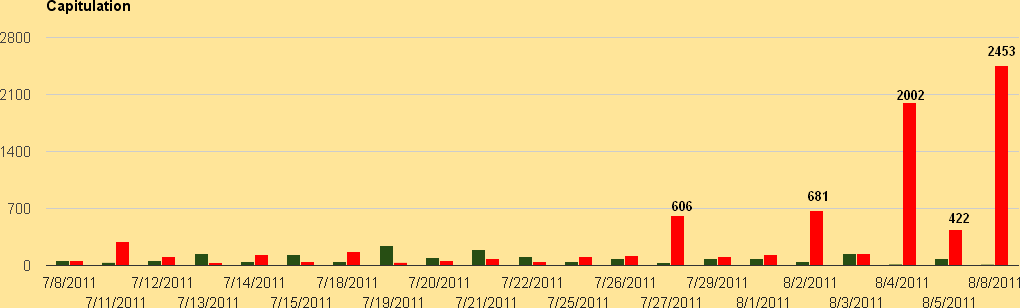
When addressing what is or is not panic, moves in the indexes can be deceptive. One way to reduce the noise of wild intraday market swings is through assessing the underlying market breadth in relation to these swings and quantifying and modeling what a panic/capitulation scenario looks like. For this, I use the number of stocks that have increased or decreased by 4% or more on increasing volume from the previous day. Using this criteria and reviewing the numbers in 2011 allows for panic to be depicted visually. What this chart shows is that prior to the flush when there was a rush to the exits the number of stocks decreasing by 4% on increased volume from the previous session hit very high numbers as there was a stampede to exit.
 |
| Panic Selling |
Comparing this to now there are a few nuances. The most obvious is that there are a number of days that had larger selling and that this selling has been persistent over the past few weeks. At first the selling was not remarkable for there were only 2 days above the 300 threshold, but over time it becomes and added together there was orderly distribution occurring during this period that was significant, but not yet panic. With a 500 day now occurring, this may be the initial stages of exiting at any cost exemplified through deleveraging and margin calls as bids dry up and no buyers are to be found and prices rapidly depreciate and shorts smell blood in the water.
 |
| Persistent Distribution Sans Panic |
The USHL also depicts what a panic/capitulation scenario looks like as the numbers drop to -3000+. Currently it is at -271 which by no means is an extreme bottom formation reading suggesting that even though there has been orderly exiting a number of stocks have still held up well. As long as these stocks hold up well, the indexes in turn will mask the broader weakness under the surface until they in turn can not longer find bids, selling hits the tape and shorts begin to look for new targets. When markets deteriorate few stones are left unturned so there is plenty of kindling left to add to the fire.
 |
| No Panic |
Currently the market is not particularly healthy and volatility is on the rise and a number of conditions for a flush are being met so this is one scenario to be anticipate. Regardless of whether this move ends in panic and capitulation or merely through distribution until there is no one willing to hold up bids remains to be seen. The importance isn't having this play out exactly as anticipated, but merely being aware of and prepared with contingency plans based upon probable outcomes and scenarios.
Thursday, February 16, 2012
Reality Based Trading- Balancing What You Want with Who You Are
Breaking down some numbers today it's become abundantly clear that the metrics I'd like to achieve and what I've accomplished are night and day. This is a principled example of cognitive dissonance and the resolution to this is not 100% clear, so I thought it in my best interest to externalize the conundrum in an attempt of ascertaining coherence.
Ideally my benchmark to achieve is a risk/reward ratio of 3-1. This number is not something I've simply pulled out of my ass --it is completely rationale and here is why; Cognitively it has been shown that the human brain reacts approximately 2.5x more to losses than gains which means that for each loss the gains to balance the internal state should be 2.5 or more. Given this, my thoughts were that if I could maintain this ratio the internal balance of my mental state would be more harmonious and would lessen the discomforts I have at times being in a trade.
The problem is that I've latched onto this anchor and continue to hold to this metric as a goal to achieve while in turn completely neglecting the information my trades are telling me. Here in lies the crux of the problem; what I'd like to achieve I have thus far been unable to do with consistency. In turn I have ignored the profits achieved consistently resulting in sub-par performance. The result is that this has done anything but appease my internal state and in fact it has simply increased frustration and exasperation.
Currently what I have shown myself capable of is a 58% success rate with an average of 1.17 R/R. I have not shown I am capable under the current market conditions to extract 3-1, let alone 2-1 with consistency so it is to my detriment to hold onto this view any longer. In fact, given that my time frame is 5 days I can simply take the max high over this time compared to entry and note that the average has only been 4.8% to begin with. Couple this with my current average profit extraction of 3.93% and I'm really not missing much profit and in fact causing detriment to my productivity in attempting to extract more.
Given this I can only come to the conclusion that it is time to stop fighting the reality of the situation and to accept fully what my personal performance is indicating to me. Which in turn means I will have to modify my plan for the time being. This isn't to say that I'll completely give up on reaching for 2.5+ R/R, it simply means I'll also have to let my metrics show me when I am capable of that. Once my stats begin to show me I am costing myself by not holding on a little bit longer and maximizing potential profit I'll adapt.
Breaking it all down trading in it's essence is simply a game of numbers and probabilities. Each trade increases our sample size and inches us closer to truths about who we are as traders at any given time. One of my priorities written in my trading plan this year was to become more aware of how my numbers speak to me; and given the number of trades I've taken thus far the outline is starting to become a story and it's time for me to start listening.
In keeping with the theme, here are some key formulas to be aware of for trading:
Risk of Ruin is a gambling concept and an important calculation to understand. This is the ultimate calculation a trading strategy is measured against for if ruin is reached that's it --no mas. While a near 0 risk of ruin is not a guarantee that one will not blow up their account, it is important to be aware of as an indication of how well one is trading. If this number begins to increase somewhat significantly it is a good clue that one is not in cadence with the market or that ones strategy is not currently working or worse, one is not trading well at all regardless of the market or the method.
There are two caveats to consider in this calculation. The first being that it requires gains to be larger than losses. Obviously a 50% success rate where losses are twice as large as gains will lead to ruin but it is also important to acknowledge that trading is not a zero sum game. While it is true for every winner there is a loser, it is also true the house wins. A series of ten flat trades can still burn 1% of an account.
 |
| Risk of Ruin |
Expected Value is another important concept to understand. If you don't know the expected value of each trade you are doing yourself a disservice. In conjunction with a near zero risk of ruin this is the second factor that must be taken into consideration: a +EV system. Knowing these correlations will greatly assist in understanding the risk that is being taken. If the system is not positive and there is an 8% risk or ruin why is the system being traded at all? If it is marginally positive, where can things be tweaked to improve performance or reduce risk?
 |
| Expected Value |
If the first two are positive, then the tweaking comes in the form of personal performance statistics. Figure out what stats are important. I trade with a 5 day time stop so I keep track of how the trades I take perform on this time frame whether I get stopped out or exit before then. Additionally what has been critical information for me to know is if the days close is higher than entry and if the second day has a follow through. A secondary piece of information I watch is the max high over the 5 day period which further heightens the discrepancy between what the stocks over my time frame were capable of moving from my personal desires. You're numbers won't lie to you so deducing this information is absolute imperative.
Subscribe to:
Posts (Atom)